One Assembly. Two Dataspaces. One Query.
How PMDCO (PMD Core Ontology) bridges incompatible industrial schemas across Catena-X and Manufacturing-X.
Catena-X
Manufacturing-X
 See the demo ↓
How PMDCO (PMD Core Ontology) bridges incompatible industrial schemas across Catena-X and Manufacturing-X.
See the demo ↓
Catena-X and Manufacturing-X each expose material data through their own schemas — SAMM (Semantic Aspect Meta Model) aspect models for polymer properties, AAS (Asset Administration Shell) 3.0 inspection documents for steel certifications. A conventional integration requires a bespoke adapter for every pair of schemas.
The PMD approach is different: each dataspace's data is converted once into PMDCO (PMD Core Ontology)-conformant RDF, loaded into a shared triplestore, and from that point forward is queryable together using SPARQL — regardless of the original format.
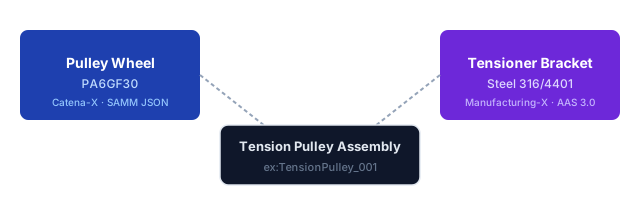
The Tension Pulley Assembly demonstrates this: one physical part, two components sourced from incompatible dataspaces, unified by a single cross-dataspace SPARQL query.
CatX ──adapter──► MfgX
CatX ──adapter──► Lab
CatX ──adapter──► …
MfgX ──adapter──► ERP
…
N schemas × M targets
= N×M adapters
CatX ──► PMDCO ◄── MfgX
         ▲            ▲
        Lab           ERP
    one shared layer
    N queries possible
    0 additional adapters
Run each node individually — inspect the data it handles, then mark it complete. The knowledge graph inspector updates live.
In-browser Oxigraph WASM triplestore — triple counts update as each node loads data.
Use the Run button in the Knowledge Graph State panel to execute the query. Load at least one source node first for results to appear.
| Component | Material | Property | Value | Unit |
|---|---|---|---|---|
| Run the pipeline nodes then click ▶ Run to execute the live query. | ||||